Refineries worldwide are evaluating non-conventional hydrocarbon streams as part of feedstock diversification strategies. Drivers include petrochemical integration, decarbonisation pressure, crude quality evolution, and circular economy policy incentives. Advanced recycling technologies have positioned plastic recycling oil (PRO) as a potential refinery feed candidate, particularly in conversion-intensive sites equipped with FCC and hydroprocessing capacity.
Several refineries have initiated controlled co-processing trials of plastic-derived streams at blend ratios typically below 5 - 10 wt%. While initial results demonstrate feasibility at limited scale, broader integration introduces structural considerations. Unlike vacuum gas oil (VGO) or straight-run distillates, PRO streams may exhibit:
Bromine numbers often exceeding 50 - 80 g Br/100 g.
Nitrogen concentrations in the 1000 - 5000 ppm range.
Trace halides (tens to low hundreds of ppm).
Batch-to-batch variability linked to upstream waste composition.
These characteristics influence hydrogen consumption, coke formation, corrosion exposure, and catalyst performance. Integration feasibility therefore depends not only on unit compatibility but on refinery-wide hydrogen balance and structural operating margin.
This article outlines a structured integration methodology linking escalation depth to hydrogen exposure, operational sensitivity, and capital commitment within complex refinery environments.
Feed qualification and stability discipline
Integration begins with rigorous feed qualification. Because PRO may exhibit compositional variability depending on upstream feedstock and processing severity, qualification must assess both absolute properties and variability envelope.
Minimum analytical parameters should include:
Density and simulated distillation.
Bromine number.
Micro carbon residue (MCR).
Nitrogen and sulfur.
Total chlorine.
Trace metals (Na, Ca, Fe, Zn).
Elevated bromine number correlates with higher hydrogen demand and increased coke potential. Stabilisation hydrogen consumption may increase by 10 - 30 Nm³/t relative to conventional VGO depending on unsaturation level. MCR increases of 0.3 - 1 wt% above baseline may translate into measurable coke yield shifts in FCC service.
Chloride levels above low tens of ppm can contribute to ammonium salt formation in hydroprocessing cold-end systems if not properly managed. Nitrogen levels above typical VGO ranges increase hydrogen consumption and may shorten catalyst cycle length.
Stability testing is equally important, particularly where storage and logistics introduce residence time variability. Thermal ageing and storage observation help identify gum formation or phase instability prior to unit exposure.
Multi-batch sampling is recommended before increasing blend ratios. Escalation beyond pilot ratios should remain conditional upon demonstrated compositional repeatability and stable hydrogen consumption profiles. Repeatability of composition is as important as single-batch compliance.
Integration architecture: the value ladder concept
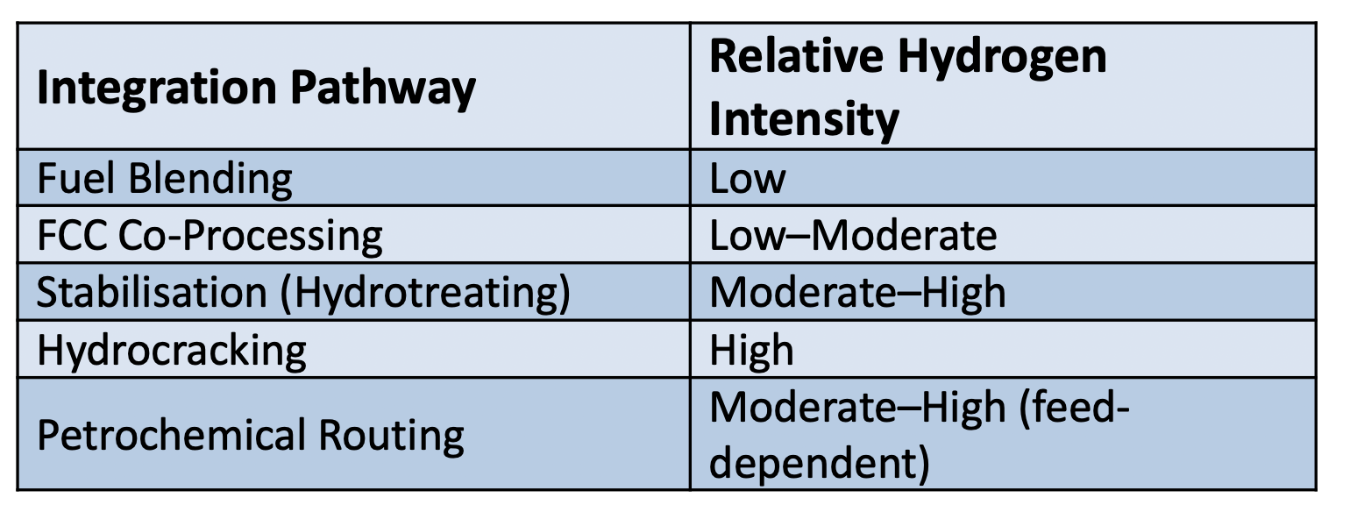
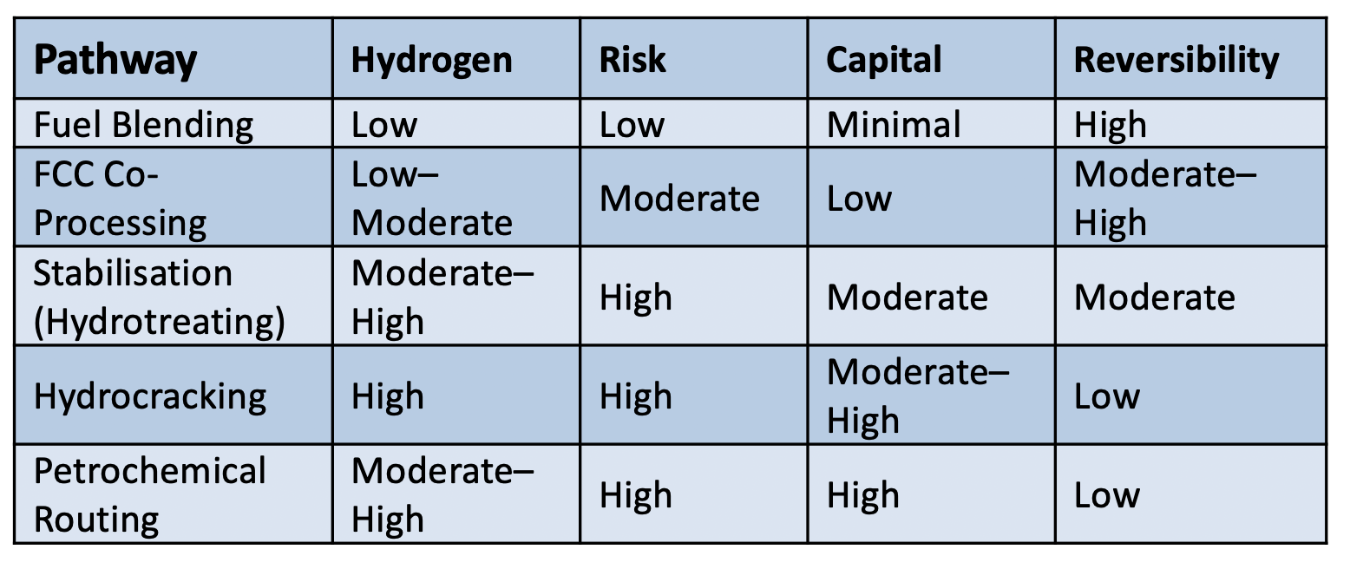
PRO integration can be visualised as a progressive value ladder in which each step upward increases value potential but also hydrogen intensity, operational sensitivity, and capital exposure.
Fuel blending represents the lowest integration depth. Hydrogen exposure is minimal, and reversibility is high. However, value uplift is limited.
FCC co-processing introduces higher value through gasoline and LPG production. Typical blend ratios remain below 10 wt% during initial evaluation. Elevated unsaturation or MCR may increase coke yield by 0.2 - 1 wt% depending on severity, affecting regenerator air demand and wet gas compressor margin.
Stabilisation through hydrotreating marks a structural transition. Olefin saturation and heteroatom removal increase hydrogen demand, potentially by 10 - 40 Nm³/t depending on feed characteristics. Chloride management and guard bed capacity become critical.
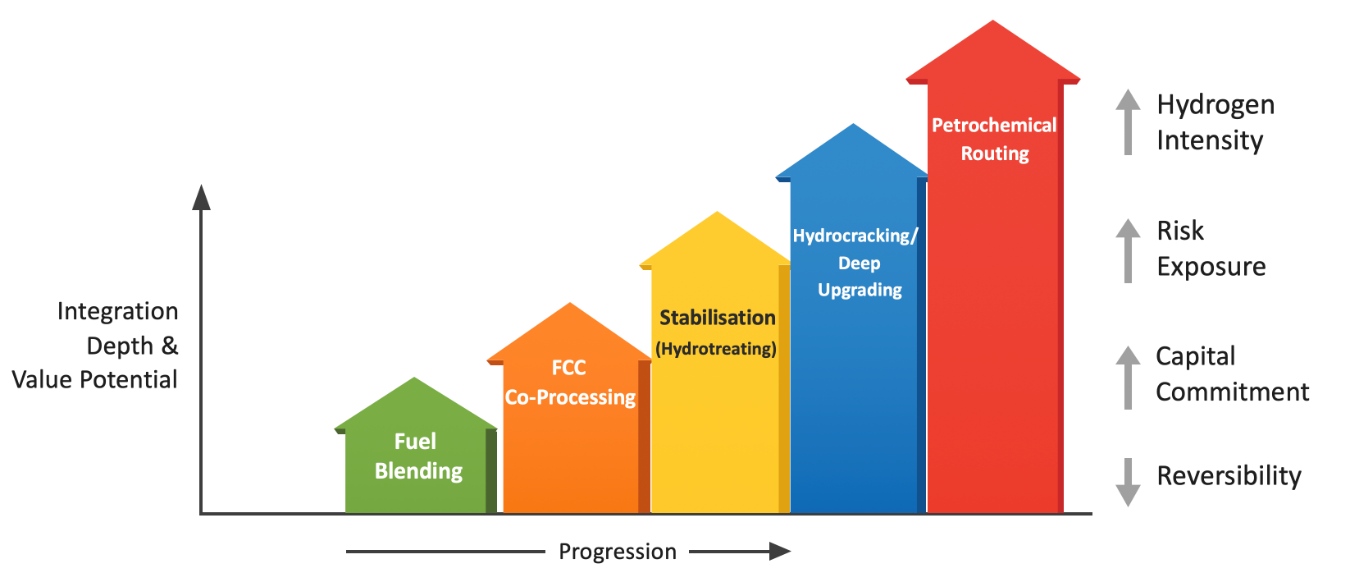
Hydrocracking or deep upgrading provides higher product value but materially increases hydrogen intensity and embeds the stream within high-pressure infrastructure. Petrochemical routing represents the highest value potential but requires strict feed quality control and sustained hydrogen availability.
Integration depth and structural exposure are directly and proportionally linked. Escalation should follow validated hydrogen margin and operational stability.
Hydrogen as the structural constraint
Hydrogen availability defines the integration ceiling in conversion-intensive refineries. Many facilities operate within 5 - 15% hydrogen margin under normal conditions. Incremental demand from PRO stabilisation or upgrading can materially reduce this margin.
The hydrogen envelope concept defines the operating region between total hydrogen production capacity (SMR, ATR, or recovery systems) and aggregate unit demand. Integration remains feasible only when incremental demand stays within this envelope under both base and constrained scenarios.
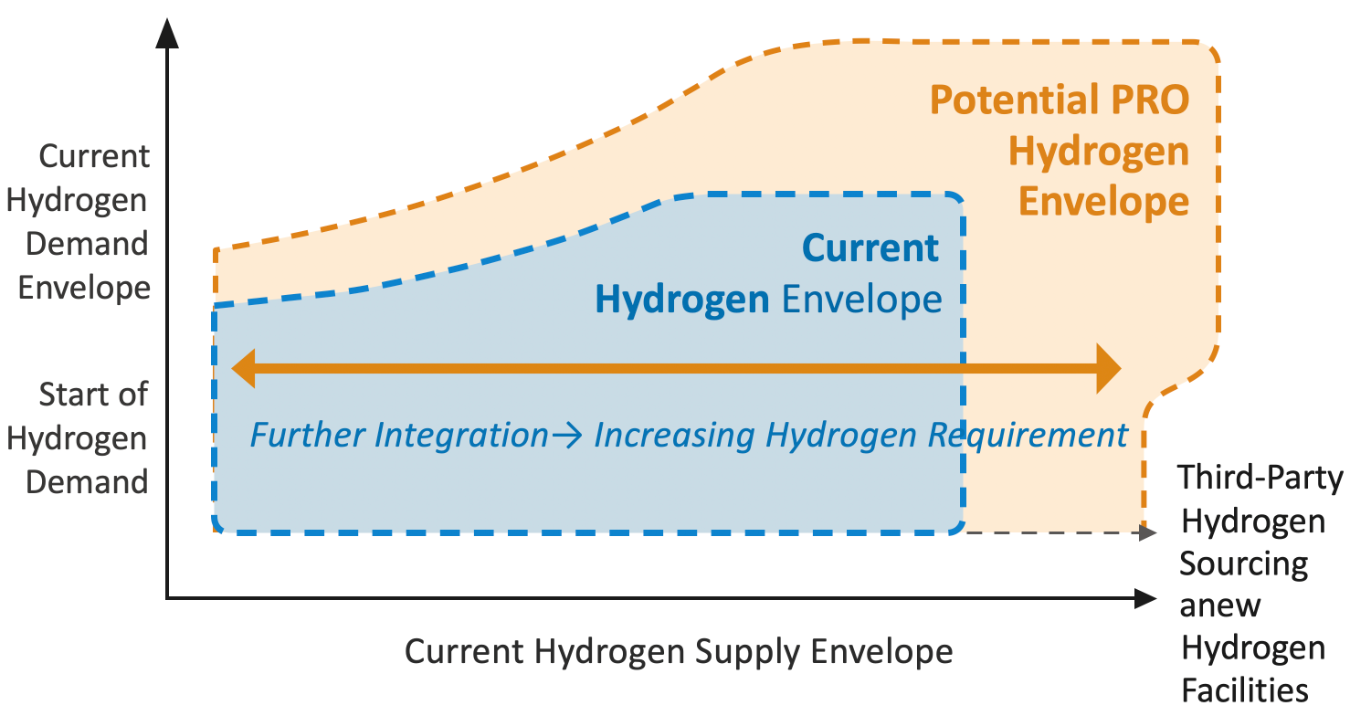
Pinch conditions may manifest through elevated recycle compressor loading, declining hydrogen purity, header pressure instability, or reduced flexibility for severity optimisation in other units. While these conditions may not immediately halt operations, they reduce system resilience.
In SMR-based systems, incremental hydrogen demand directly increases Scope 1 CO₂ emissions. Deeper integration therefore links economic value with carbon intensity implications.
Escalation beyond limited FCC co-processing requires confirmed hydrogen headroom under both outage and high-severity operating conditions.
Operational and risk considerations
Operational feasibility depends on repeatable performance under real conditions.
In FCC applications, increased unsaturation or MCR may elevate coke and dry gas yields. Even a 0.5 wt% increase in coke formation can influence regenerator temperature control and air blower loading, particularly in units operating near air blower or wet gas compressor design limits.
Hydrotreating and hydrocracking units are sensitive to nitrogen removal severity, heat release from saturation reactions, and ammonium chloride deposition risk. Monitoring should include:
Incremental hydrogen consumption.
Catalyst activity decline rate.
Chloride breakthrough detection.
Corrosion inspection programmes.
Monitoring data should be benchmarked against baseline refinery performance to quantify incremental system impact rather than isolated unit response.
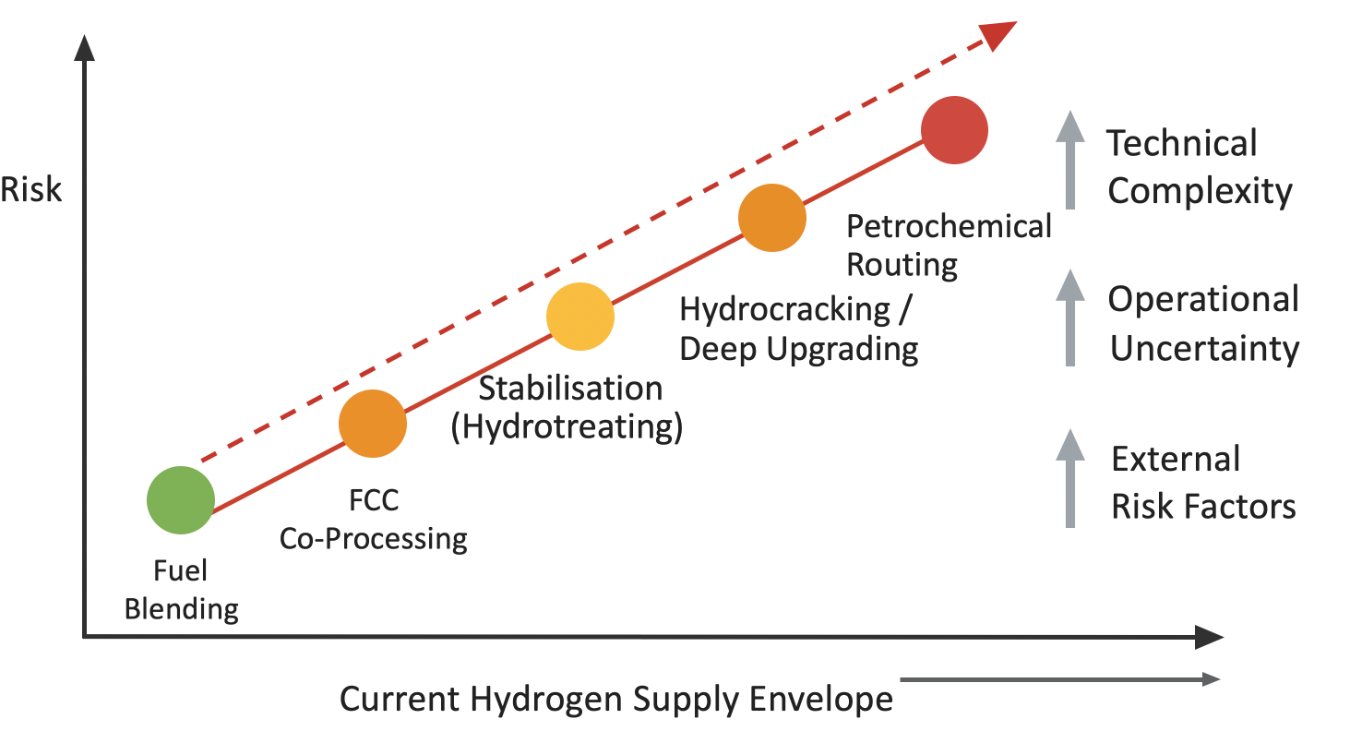
Risk escalation is progressive rather than binary, increasing in both likelihood and consequence with integration depth. Early-stage integration enables technical learning while preserving flexibility. Deeper pathways should proceed only after confirming stable performance across multiple batches.
Capital optionality and strategic implications
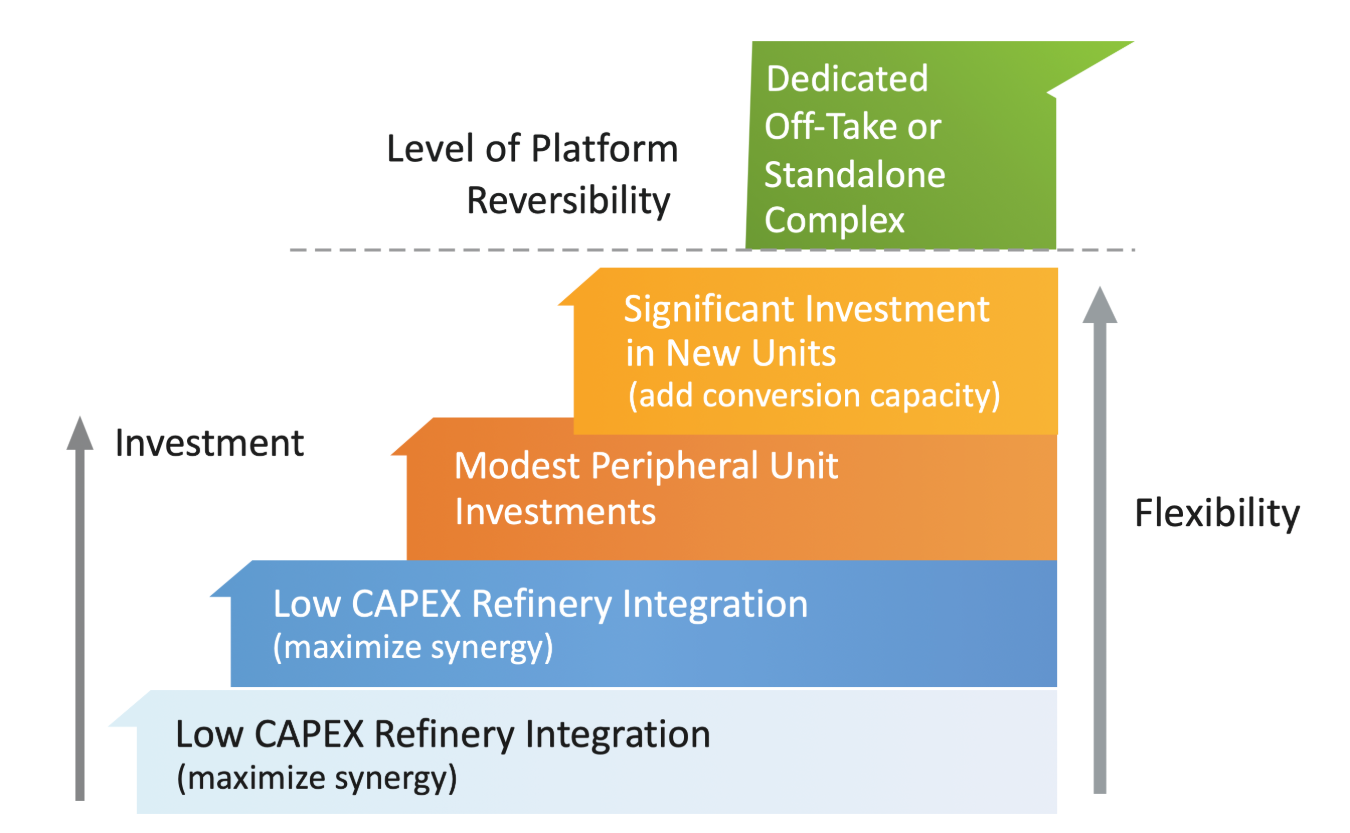
Capital exposure increases with integration depth.
Blending and limited FCC co-processing typically require minimal modification and preserve reversibility. Stabilisation may require modular investments such as guard beds, enhanced chloride management, or incremental compression upgrades.
Deep upgrading may necessitate sustained hydrogen debottlenecking or additional processing infrastructure, reducing configuration flexibility and increasing structural capital lock-in.
Capital optionality links investment decisions to validated hydrogen margin and operational repeatability. Rather than committing prematurely to high-capital pathways, refineries can escalate proportionally as technical confidence increases.
Stress testing under elevated hydrogen cost scenarios (e.g., €3 - 5/kg H₂ equivalent) is recommended to confirm economic resilience before structural investment.
Conclusion
Plastic recycling oil represents a technically viable feed diversification opportunity for complex refineries. However, integration must be governed by system-level discipline rather than isolated routing decisions.
The decisive variable is not feed value alone, but hydrogen discipline. In hydrogen-constrained systems, escalation without validated margin is not optimisation—it is exposure. Integration depth must align with hydrogen margin, operational stability, and capital proportionality.
By applying a structured technology learning framework — integrating feed qualification, hydrogen envelope validation, operational repeatability, and capital optionality — refineries can evaluate PRO integration responsibly while preserving asset integrity and long-term flexibility.
References
Williams, P.T., “Pyrolysis of Waste Tyres: A Review,” Waste Management, 2013.
Martínez, J.D. et al., “Waste Tyre Pyrolysis - A Review,” Renewable and Sustainable Energy Reviews, 2013.
Gary, J.H., Handwerk, G.E., Kaiser, M.J., Petroleum Refining: Technology and Economics, 5th Edition, CRC Press.
Speight, J.G., The Chemistry and Technology of Petroleum, 5th Edition, CRC Press.
Ancheyta, J., Hydroprocessing of Heavy Oils and Residua, CRC Press.
Meyers, R.A., Handbook of Petroleum Refining Processes, McGraw-Hill.
API Technical Data Book - Petroleum Refining, American Petroleum Institute.
U.S. EPA, Compilation of Air Pollutant Emission Factors (AP-42).